
This blog is on temporary hiatus until after the move.
Thank you for your patience.

This blog is on temporary hiatus until after the move.
Thank you for your patience.

I love encyclopedias. They give me a sense of security – all that knowledge lined up on a shelf!
Encyclopedias are about an orderly arrangement of knowledge on a particular subject or a range of subjects. The date of the encyclopedia puts it in the context of its time. The online Brittannica has an interesting story about the history of the encyclopedia and its evolution here.

When I was a kid, my mom got me the Brittanica Junior Encyclopedia. Red bindings, gold lettering. The local grocery store had a special, where if you bought X amount of groceries, the volume of the week was $2.95. It was rough for my mother, who was widowed, and handling everything on her own, but we managed to collect the whole thing. I was thrilled, and read each volume as we got it. I used the set for years. I still have it in my office.

We also managed to collect the Audubon Nature Encyclopedia. We had a subscription for one volume a month. Again, I was thrilled whenever the new volume arrived, and everything stopped while I read it.
I didn’t just read them when I had a paper to write in school. I read them because I enjoyed the new-to-me information, and it got me interested in things that weren’t being taught in school.
Again, I still have the entire set in my office. And I still refer to them.
I always wanted a grown-up encyclopedia set. I didn’t say anything to my mom for years. I knew how hard my mom had worked to make sure I had the two mentioned above (and I contributed from the money I earned babysitting, when I didn’t spend it on Nancy Drew books). When I was old enough to buy it myself, I was living in a NYC apartment, where there wasn’t room for the other books I kept accumulating, so there certainly wasn’t room for a set of encyclopedia.
But I never stopped wanting it.
A couple of years ago, a set of World Book encyclopedia came up on the local craigslist. I jumped on it, made arrangements, and drove out to Harwich to pick them up – contained in several heavy boxes. They are in superb condition. They sit, prominently, in my office.
They make me feel secure.
Sometimes I pull a volume out, open it at random, and read.
I’m sure it’s tied to my love of libraries, and doing research in libraries and archives, something that started when I was a kid and got my first library card. The hours spent in school libraries and the local public library have evolved into visiting libraries when I travel, or traveling to visit a specific library or archive during research.
Reference sections used to carry a wonderful selection of encyclopedias. I hope some still do, although at least one local library I know got rid of their reference section because “it’s all online now.” Which isn’t true – you don’t get the snapshot of a particular era without the book itself.
Even Brittanica is online now, and there are a wealth of other online encyclopedia, including those encompassing the parts of history that were ignored or (literally) whitewashed. But there is something comforting and thrilling about holding a volume of an encyclopedia in my hands and sitting in my reading chair to read it.
It makes me feel connected to writers, scholars, and readers in the centuries before me, and to the writers, scholars, and readers to come, who will continue to use physical books in tandem with electronic resources. It connects me to the love of knowledge.
I’m aware that the information within them is dated, and skewed toward the established white point of view. We can and will do better moving forward (especially when we stop allowing a text book firm in Texas to supply biased materials to the education system). But I still use them as a jumping off point. I can look something up – recognizing red flag words and references – and then use what I read to start the search for other sources. I can disagree with information printed on the pages, and still value the desire to collect information.
I’m looking forward to someday living in a place where I can unpack all my books. You can be sure all three sets will be proudly displayed.

I have not yet read this book, although I’ve ordered it and have every intention of reading it.
But with what’s been going on in this country, and the worries for violence at tomorrow’s inauguration, it’s a solid choice.
NPR has an interesting interview with Dan Rather here.
He is one of the most trusted voices of my lifetime, and continues to be a voice of sanity, courage, and justice.

At the turn of the year, I saw numerous posts about reading goals. I’m always happy when I see people commit to read more – and even happier when I see them actually doing it.
I read a lot. I carve out reading time every day. Often, it means not watching TV or videos, which is just fine with me. In the days when I wasn’t staying at home due to the pandemic, I made sure to carry a book (or my Kindle) with me at all times, so that anytime I was stuck waiting – or commuting on public transportation – I had something to read. I carry a notebook and pen with me, too, in case I decide to get some writing done, but that’s a different post for a different day.
I learned my alphabet early. My mother still tells the story of us being on a bus in Chicago when I was about 18 months old, and I pointed out the different letters in the signs on the bus (loudly). I remember leaning to read from the book GREEN EGGS AND HAM – my mother tells me I was just over two years old when she taught me to read.
Both parents were big readers (my mother, at 96, still reads for several hours every day). So, of course, I was a reader, too. And going to the library became a favorite adventure when I was little. I got my first library card at the Rye Free Reading Room in Rye, NY, when I was six years old – the earliest it was allowed.
I don’t trust people who don’t have books in their living or working spaces.
Someday, I will live in a house big enough so I can unpack all my books.
I don’t post my reading totals at the end of the year, because people wouldn’t believe them, and I’m not arguing with them. I’d rather spend that energy. . .reading.
From January to May, for instance, I read – yes, actually read – over 100 books for a contest I judge. And I’m a paid reviewer for a publication, so I read regularly for those assignments.
But that doesn’t stop reading as much as possible for pleasure.
Last Sunday, for instance, I read three books. My body needed the rest, and my soul needed the restoration. I read the remaining two books in a mystery series I’ve enjoyed; in between, I read a small nonfiction book that was recommended to me, but I found filled with privilege and making excuses for it. Glad I read it; didn’t like it.
It was a good day.
I did some puttering around and some cooking. Some percolating on writing for the coming week. Too much time on social media, waiting for damn Congress to hold the domestic terrorists accountable.
But mostly, I used reading to restore my wounded soul, and rest my body.
Had the weather been warm enough, I would have read outside, on the covered deck, where I spend as much time as possible in spring, summer, and fall. I love reading outside.
I used to take books to the Ashumet Sanctuary over in Falmouth and read amongst the hollies (which are among my favorite trees).
As far as goals, I don’t set a number of books to read. I think it’s great when other people set a number and then work to hit it, but that’s not how I like to structure my reading.
My reading goal is to expand my reading. I read a pretty wide range, but especially in the mystery/suspense/thriller genres, and I read a lot of nonfiction, especially when I’m researching my own writing. I enjoy fantasy, steampunk, some science fiction, uncategorized fiction, historical fiction. I read some romance, but I’m more likely to read books with romantic elements. However, when I’m in the mood for an uplifting romance, I have a wonderful ensemble of authors I trust to give me a good experience, and I’m always happy to expand it.
One of my favorite things, when I worked as a librarian, was keeping up with new releases, and choosing a large variety of books that I thought patrons would enjoy.
Whether it’s for myself or others, a review of a book matters less to me than the blurb. If the blurb is interesting, chances are I’ll ignore reviews and make my own decisions.
My review assignments cover a wide variety of fiction and nonfiction. Every time I pick up a book, whether it’s for review, or a contest entry, or something I ordered from the library – I hope to fall in love with it. I read books on recommendations from friends and acquaintances IRL or on social media. If I see a post about a book and it looks interesting, I’ll give it a try. I belong to my university’s online book club – the Voracious Violets of NYU. They’ve introduced me to books I might not have found on my own.
I miss being able to browse library and bookstore shelves – once I’m vaccinated, and things safely open back up again, that is one of the things I will add back in to my life as quickly as possible. I especially miss browsing secondhand bookstores. I’ve been introduced to some wonderful new-to-me authors by finding them on secondhand shelves, and then buying new releases as they come out.
I read for pleasure, but, as a writer, every book I read teaches me something. When the author does their job well, I see the world in a different way, and I think about it far beyond the time the book is finished. I also learn craft from every book I read, even if it doesn’t work for me. How are the characters developed? Is the setting used well? Is the book structured well, with a strong, internal rhythm that’s as unique as a heartbeat? Does the author understand the genre enough so that, when breaking the formula, it’s a structured choice, and not just carelessness?
I started keeping a reading log a few years ago, in a black-and-white covered composition book. I note the date, title, author, publisher, copyright date, and from where I got it – library, if it’s a review assignment, if it’s one of my own books – and then I write a couple of sentences of impressions. I can go back and look things up, and see how my frame of reference was influenced by what else was going on around me.
A year or so ago, on this blog, I did a Readers’ Expansion Challenge, where every month, I tried reading something out of my usual repertoire, and encouraged other readers to do the same. I’m not doing anything as formally as that this year, but I do plan to continue to expand my reading so I’m not just reinforcing my standing opinions.
I like fresh perspectives on the world, and reading offers that in a far more intimate way than anything visual. Reading is internal, living in your heart and soul and brain, as much as it is the external of holding the material and having eyes translate it to brain. I like the intimacy.
Enjoy your year of reading!
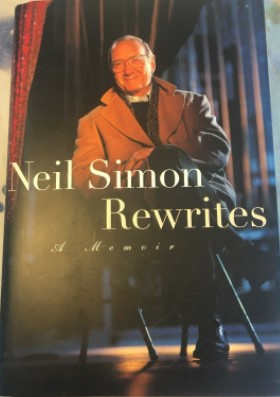
One of my favorite traditions is choosing my first book of the new year.
In normal years, I’d take my time, making the rounds of my favorite bookstores, taking hours – or days – to browse, until I found what spoke to me, what fascinated me, what I hoped would set a positive tone for the coming year.
Of course, nothing was normal about this past year or about preparing for 2021. Yes, I looked at plenty of online shops, and there were many choices. But the tactile portion of it was missing.
I could have rooted through books I’ve bought over past years and never read.
But I did not do so.
Instead, I chose one of the books I’d gotten from my library, Neil Simon’s memoir REWRITES. Why not learn from a hugely successful playwright? I made the choice shortly after submitting two plays ahead of deadline, and putting in a proposal that means I might write at least three new plays in 2021.
I’m reading several books around this book – I’m not rushing through it. I’m savoring it. I was not fortunate enough to work with him while I worked in theatre in New York, but his work was an enormous part of my life during my theatre career working my way up to Broadway, and when I was actually ON Broadway. We’ve worked with some of the same people (six degrees of Kevin Bacon), but never worked directly with each other.
It was also reassuring that I’m not the only writer willing to cut what does not work! I can also learn from what he learned did not work in his own plays. There are so many asides that make me laugh, and so many experiences to which I can relate. And several I’m glad I’ve avoided.
As I said above, I’m savoring it. Considering the ideas for stage plays I have percolating in my head, lining up in order to spill out onto the page, I think it was a good idea, on both professional and personal levels.
I remember several years ago, when I chose a literary novel as First Book of the Year that sounded interesting, built around some recent historical characters, but fiction. Only then I started reading it, and one of the main characters was committing pedophilia and I was . . .supposed to like him? To say it didn’t work for me is an understatement. I did not finish the book and got rid of it. That poor choice felt as though it tainted months into the year.
I don’t sit there and decide, “This year I’ll start with fiction” or “This year will start with non-fiction.” I choose the book that draws me at the time. As I do my browsing through shelves, what I’ve read about various books and recommendations from individuals I trust come to mind. But I’ve rarely left the house knowing what book I sought.
This year, as I tried to decide with what I wanted to start my year, I definitely wanted it to be something centered around theatre. Again, not sure at first if I wanted fiction or non-fiction. I’m more than tired of the ridiculous clichés in novels, especially in cozy mysteries, that paint those involved in theatre or film as not very bright, very selfish, and horrible people. The tone is often patronizing, the author (and the protagonist) looking down on theatre people. Meanwhile, they’re usually written by people who went backstage to one community theatre production and don’t know what they’re talking about, and certainly don’t have the physical stamina for eight shows a week, or the mental capacity to learn two hours’ worth of lines and blocking. I definitely wanted to avoid one of THOSE novels (to be fair, I am writing my own fiction centered around theatre and theatre people that actually recognizes the work, dedication, talent, and intelligence it takes to create a career in the business).
With my scripts, whether they are for stage plays or radio or screenplays, I want every script to be better than the one before. I want to take what I’ve learned from the previous process and apply it. I do this in novels, too, but because scripts involve other people more than novels do (or, at least, more people), there are often more tangibles to take from project to project.
When I came across the Neil Simon memoir, that resonance happened, like a tuning fork pairing with the right note.
I’m glad this is how I started, and I hoped to build on this year positively, as both a reader and I writer.
What reading are you starting with this year?

This is a romantic little Christmas short that I wrote a few years ago. I was part of a live Facebook event for a group of romance writers, promoting what was then ASSUMPTION OF RIGHT (which was later re-released as PLAYING THE ANGLES and is the first of the Coventina Circle series).
I wanted to have a giveaway for the readers who participated in the event. A few days before, I sat down and wrote this little Christmas romance. I don’t often write straight-up romance – it’s one of the hardest styles to get right, especially with a hint of comedy in it. But I stayed up late for several nights, got it up on Smashwords, and created a coupon so that all the participants could download it for free. Once the participants were done downloading, and it was up there for less than a dollar, it’s continued steady sales over the years, and people enjoy it. So I thought I would re-release it on a broader platform.
The cover image is in the public domain. Much as I’ve played with other cover images over the years, I love this one, and decided to keep it, when I decided to re-release the short through other channels this year, taking it off Smashwords.
The piece has gone through some tweaking, and I added an extra scene to up the conflict. But Edwina’s determination and kindness, and Theobold’s strength and admiration for those qualities remain.
This is a novelette, just under 10,000 words, and I hope you enjoy it. Some of the buy links are live now, and more will be added. You can always visit the Stories page on my blog for the most complete list of links. It is also categorized as one of the Delectable Digital Delights.
Blurb:
When a dark, mysterious stranger arrives on Edwina’s snowy doorstep on Christmas Eve, is he the answer to saving her beloved family home, or another threat?
Edwina Lockesley is desperate to save her family home from a conniving neighbor who claims the house –and her — in payment for a debt. When Theobold Vertingras shows up on the doorstep in a Christmas Eve blizzard, will he help Edwina coax the hall’s ghost to give up her secrets in order to save the manor? Or is Theobold there to complicate matters even more — especially since Edwina finds him so attractive?
Exceprt:
“Oh, bother, must you interrupt just as the ghost is about to reveal her secrets?” Edwina Lockesley swung the large, carved wooden door open and glared at the poor soul on the doorstep, nearly paralyzed by the howling winter storm.
“Ah, I, well–“
He was tall, and, Edwina supposed, rather good-looking if you liked the sort. He must have topped six feet tall, with dark hair and dark eyes. The planes of his face were sharp, and his nose a bit too long for traditional handsomeness. The snow fell around him in large flakes, landing on his cloak and not even melting. “You’re not a ghost yourself, are you, sir?” She stared at him with keen interest. If they’d conjured up a completely different ghost, well, it would be a completely different story.
“I will be, my lady, if I don’t get out of this storm soon.”
“It wouldn’t be very Christmas-like if I left you out on the snow on Christmas Eve, now, would it?” Edwina continued. “I suppose you have a horse?” She peered past him. “Oh, a lovely one at that. Let me just slip into my boots and fling on a cloak. I’ll take you round to the stable.”
Several cats fled up the stairs. A trio of dogs of undetermined parentage heaved themselves to their feet. “No, dears,” she told them in a gentle, firm voice. “You stay here. It’s too cold for you outside.” She looked at the man on her doorstep. “I hope you don’t mind dogs and cats. We have rather a lot of them. Abandoned animals tend to find their way here.”
“Don’t you have a groom–“
“Mrs. Fengest! Unlock the door to the stable passageway so we don’t have to go all the way round when we come back from the stables, will you? There’s a dear.” As Edwina spoke, she slipped into a pair of a man’s lined boots far too big for her. She grabbed a cloak and some gloves from pegs on the wall. “Warm up some supper and get a room ready, please. We’ve got an unexpected guest.” She gave the man before her a bright smile. “Now, then, let’s get started. Right this way.”
She trudged past him, to where the large, coal-black horse stomped and complained in the drifting snow. “He’s lovely. We’ll make sure he’s well-fed and rested. We’ve got plenty of supplies put by, so even if you’re stuck here for a few days, all will be well.” She petted his nose and he nuzzled her. “You’re a handsome one, aren’t you?” she crooned. She took his reins and led him around the side of the house, the man stomping behind her.
“Don’t you want to know who I am?” he demanded, as they headed for the stable block, attached to the house by an enclosed stone passage.
“It would be nice to have a name and not just refer to you as ‘man’, ” Edwina agreed. “Although I warn you, Miss Petal may do so anyway. My goodness, the storm’s certainly picked up. We haven’t seen one this bad in quite a long time. Makes sense; after all, it is winter.”
“My name is Theobold Vertingras.”
He looked at her as though he expected her to recognize the name. Edwina didn’t care if she should or not. “You are welcome here, Mr. Vertingras, to wait out the storm. We don’t stand much on ceremony or formality, and you will have to adjust. But we do offer hospitality. I am Edwina Lockesley.”
“Daughter of Edmund?”
“And of Tabitha. Niece of Reginald. We could go back through all the begetting, but it would be quite boring.”
———-
99 cents on all channels.
Universal buy link

This piece, under the Ava Dunne byline, mixes mythology, Yule traditions, romance, mystery, and fantasy, all in one novelette just over 10,000 words.
Samantha Wright has a problem. The attractive Kris Teague crash- landed his sleigh and eight not-so-tiny reindeer in her driveway. His uncle Nick happens to be THAT Nick – as in Claus – and they need Samantha Wright’s help to turn back the Four Horsemen of the Apocalypse at one of the Universal Gates not only to save Christmas, but keep Earth turning. A fresh, romantic comedy turn on Yuletide myths and traditions!
It was an absolute delight to write. Even though it’s quite a few years old at this point, it still makes me happy when I re-read it every year. I hope you have as much fun reading it as I had writing it. This is very much a case of me writing the piece I looked for, couldn’t find, and wanted to read.
Here’s an excerpt:
“Are you mad that I told Dad I had a stomach bug when I really didn’t, just so I could come home?”
“It would have been nice if you hadn’t waited until you were at the airport on Christmas Eve in the middle of a snowstorm. If they weren’t on a private plane, they’d never get out of here tonight. Driving to and from Logan on a lovely summer’s day is hardly my idea of a good time, but in this weather. . .”
“I was desperate.”
“I understand why you did it. In a perfect world, you could have told him you were uncomfortable and why and made arrangements, but in this case, yeah, I see why you did it. If you hadn’t said you were sick and grossed out Alyssa, he would have made you do whatever felt wrong so you’d learn to do his version of manning up. I don’t want this to become a pattern, faking illness to get out of doing stuff you don’t want to do, but in this case, I do understand, and I’ll let it go.”
“I promise it won’t be a habit, and I promise I won’t ever do it with you. I’ll just tell you when something bugs me.”
“Okay, we have a deal.”
“Hey, what’s happened at the foot of our driveway?” Liam leaned forward. “It looks like an accident.”
I pulled into the lip of the driveway to the red Colonial I’d bought in the summer. Snow was stacked up against the fence, left by the town’s plow brigade. In the snowbank was what looked like an overturned sleigh and a bunch of livestock. I pulled out my phone to call 9-1-1. Nothing. No signal.
“Are those reindeer?” Liam’s mouth dropped open.
“I’m not sure.” I got out of the car on my side. Liam got out on his side, and Simon shouldered his way over the seats and out of Liam’s door. As we got closer to the livestock, I saw they had antlers and large, liquid brown eyes. Some of the harnesses broke, and they stepped through the snow, the bells on the remaining strips jingling. None of them looked as though they were hurt, thank goodness.
I turned to Liam. “I think they are reindeer.”
“Cool,” Liam responded.
I wasn’t so sure it was cool. Yes, I had a barn. I even had a trio of rescued horses in it and supplies. I counted — eight — where the heck could I put EIGHT reindeer?
Eight. Reindeer. I was getting a really bad feeling about this.
—
This piece is one of my favorite things ever written. It was on Payloadz way back when, then moved over to Smashwords, and is now OFF Smashwords and distributed via multiple digital channels. Amazon is refusing to carry it, because it’s available on other channels, even though I want Amazon to distribute it, and am not in a publishing agreement with them. I am looking at other platforms where I can distribute the mobi file.
It’s only 99 cents!
The easiest way to find the type of digital file is to use the Universal Buy Link.
For more information on all the Delectable Digital Delights, visit the website page. More holiday shorts are being prepped for re-release!

I’m happy to be back blogging about books, reading pleasures, and the rest. Something I decided to start blogging about are older books that I discover and enjoy. I don’t just read whatever’s coming out now; I like to browse and find new-to-me books and authors from whenever, because so often, a book doesn’t get the attention it deserves when it’s published, due to other noise around it.
THE SCHOOL OF ESSENTIAL INGREDIENTS by Erica Bauermesiter was published in 2009. Publisher’s Weekly gave it a lovely review.
The book is built around the healing power of food, friendship, and created community.
One would have thought I’d known about it and read it at the time. But I didn’t.
Every few months, I put out a call for recommendations of books and authors, when I can’t find what I’m craving, and not sure where to look. I’m not sure if this book came to me through one of those recommendations, or if I found it while I was browsing the library catalogue looking for something else.
What I do know is that I found it, and thoroughly enjoy it.
Lilian learned the healing power of food as a child, when her grieving mother retreated from the world into books, leaving Lilian to handle the day-to-day business of survival. Lilian learned how to cook from need, and kept experimenting until she could bring her mother back to the present. Now, she runs a restaurant that gives cooking lessons.
The book follows the transformations and relationships built among her and eight students in one of her sessions. The characters face challenges, especially those of the heart and soul, which is a nice change from novels that have the Fate of the World as their fulcrum.
It’s a quiet novel, but it’s also beautiful and soothing. It’s a balm for a stressful, painful time. Not everything has to be about external mayhem. There are still heart and soul issues. This book examines them without wallowing in them. Most importantly, the novel is restorative for both its characters and the reader.
If you haven’t read it, I suggest you do.
I’ve made a list of her other books, and have them in my TBR pile.
Enjoy, my friends. Peace.

I’m a big fan of Barbara Ross’s Maine Clambake mysteries. When I heard she had a new series coming out last year, featuring Jane Darrowfield, I was delighted. The series opener, Jane Darrowfield, Professional Busybody, which released last year through Barnes & Noble, and this year in wide release, was even better than expected. The second adventure in the series, Jane Darrowfield and the Madwoman Next Door, is both delightful and frightening.
Jane is retired. Determined not to wither away, she has a business as a professional busybody, helping people with problems that don’t necessarily make sense for law enforcement. She’s an older protagonist who is not a cliché. She has a rich life with her friends, her garden, her business, and her growing relationship with her lover, Harry. She’s hurt by the estrangement with her son. She’s a real person dealing with changes in her life, not a trope in a formula, which is one of the reasons the series is so refreshing.
In this case, her young, successful neighbor, who recently bought the house next door, hired Jane because she’s having blackouts and hearing voices. She’s not sure if someone is harassing her or if she’s going crazy. She has a state-of-the-art smart house, with every electronic comfort possible, and even a panic room.
Jane takes the case, which escalates when Megan disappears. Megan has a successful, ruthless father, an estranged mother recovering from addiction, a best friend in the office who might not be what he seems, and a security system so complicated it needs constant service by the area’s technician.
As Jane follows each step and each lead with determination, fortitude, and an eye for detail, the web around Megan grows more complex, surprising, and frightening. As a single woman reading the book, Megan’s danger hit close to home. It’s a modern twist on the old story of betrayal of trust. The sympathy she feels for Megan’s estranged mother, mirrored by her own estrangement from her son is beautifully, delicately handled. The book is engaging and frightening, and ultimately hopeful. I loved it, read it straight through in one sitting, and am already looking to the next book.
This book is available exclusively through Barnes and Noble here.
Posts may be a little erratic here for the next couple of weeks, due to unexpected health issues. I will try to write a batch of posts soon and schedule to post.
Your patience is appreciated.
Thank you, and apologies.
 A Biblio Paradise